Soft, Stretchable Electrical Tissue Adhesive for Precision Biosensing and Bioelectronic Device Integration
Case ID:
TEC2025-0162
Web Published:
2/2/2026
Executive Summary
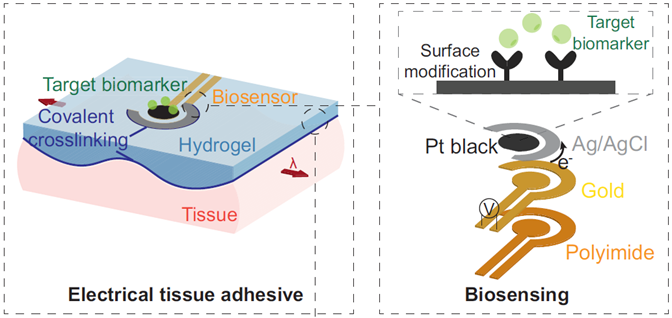
In-situ biosensing is a rapidly advancing field, enabling real-time biomolecular detection directly at local tissue sites. However, the integration of biosensors with soft, wet, and deformable tissues remains a key technical challenge. MSU researchers have created an electrical tissue adhesive (ETA) that forms fast, robust adhesive interfaces between rigid electrochemical biosensors and soft, wet biological tissues. The material exhibits high fracture toughness, low modulus, and extraordinary stretchability, while maintaining strong interfacial toughness at the sensor–tissue interface.
Description of Technology
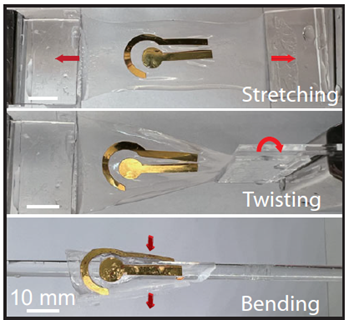
The ETA is a dry-applied hydrogel film comprising two interpenetrating polymer networks: (1) an NHS-functionalized poly(acrylic acid) (PAAc‑NHS) network that rapidly covalently crosslinks to amine-bearing surfaces on both biosensors and tissues upon hydration; and (2) a gelatin network that provides sacrificial, dissipative interactions for enhanced toughness. Upon gentle pressure (~5 kPa) and short adhesion time (~5 s) on wet tissues, the film absorbs interfacial moisture, transitions from glassy to rubbery, and establishes covalent bonds, achieving interfacial toughness on porcine skin up to ~520 J/m² with 50 µm films. Bulk properties can be tuned via hydration time, balancing modulus reduction and maintained toughness. The ETA cushions modulus mismatch between rigid electrodes (Au/Pt black/Ag/AgCl on PI) and soft tissues, mitigating stress concentrations, retarding crack propagation, and preserving electrode geometry. The TRL of this process is currently assessed at 4. Using a glucose sensor as an exemplar, resilient sensing with <2% variation was maintained under stretching, twisting, and bending and during 24‑hour wear on human skin for exercise and diet monitoring.
Benefits
- Strain‑insensitive sensing: <2% electrical variation under stretch, twist, and bend.
- Soft, tissue‑like mechanics (≈20 kPa modulus) with high fracture toughness (to ~3000 J/m²) and stretchability (to ~15×)
- High interfacial toughness at sensor–tissue interface (to ~500 J/m²) enables long-term wear (≥24 h)
- Dry-film handling for simple application; thickness tunable to optimize conformability and adhesion.
- Materials platform compatible with multiple biosensors (glucose demonstrated; lactate possible).
Applications
- On-skin sweat biosensing (e.g., glucose, lactate) for fitness, wellness, and metabolic monitoring.
- Implant-adjacent or internal organ interfacing (brain, stomach, intestine) for in-situ analyte detection.
- Stable electrical interfaces for electrophysiology, electrical stimulation, and imaging where wet adhesion is required.
- General tough hydrogel adhesive for soft–rigid bioelectronic integration in wearables and medical devices.
Patent Status
Patent pending
Publications
“Electrical Tissue Adhesives for Strain‑Insensitive In‑situ Biosensing”, Advanced Intelligent Systems, 2025
Licensing Rights
Full licensing rights available
Inventors
Dr. Shaoting Lin, Dr. Xinyue Liu, Tsz Hung Wong, Jiabin Liu, Yijie Cheng
TECH ID
TEC2025-0162
Patent Information:
| App Type |
Country |
Serial No. |
Patent No. |
File Date |
Issued Date |
Expire Date |
For Information, Contact:
Jon Debling
Technology Manager
Michigan State University
deblingj@msu.edu
